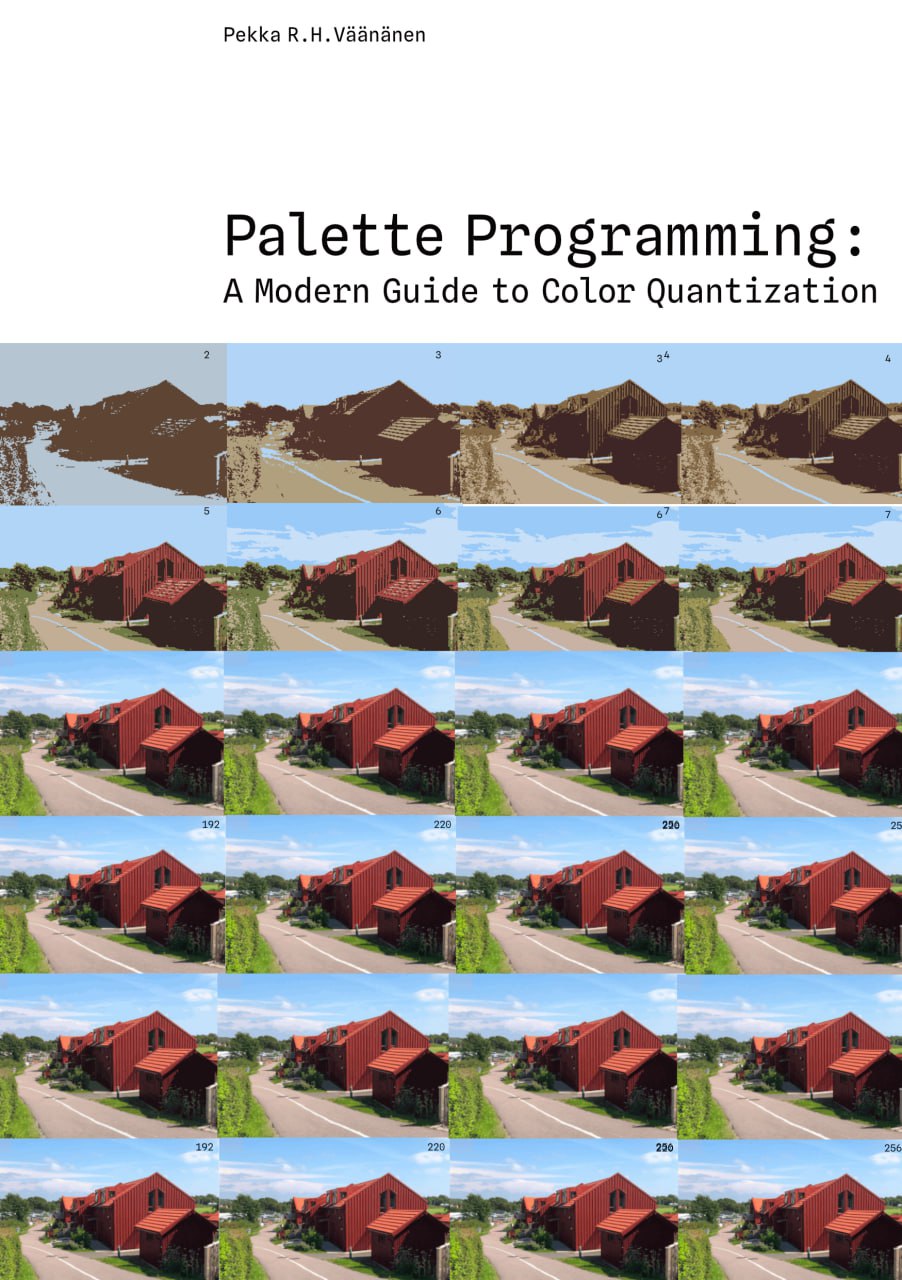
Interested in retro computer graphics?
How about numerical programming?
Here’s a book that combines the two.
Palette Programming: Invent Your Own Color Reduction Algorithm explains how to represent images using small color palettes. It’s an old computer graphics problem, but an educational one since it involves recursive algorithms, statistics, and color science.
If that sounds interesting and you are ready to take on a challenging Python programming project, then this book is for you.
You will learn about technical subjects such as:
- top-down hierarchical clustering,
- the k-means algorithm,
- color dithering,
- statistical variance, and
- perceptual color spaces.
Still, it’s a practical book. There is some theory, but only what you need to understand the code. Not an academic treatise but an illustrated guide with real code.
The book will be published in 2026. First as a digital edition, followed by a printed physical version. The digital format is a PDF in both full-size and smaller e-reader form factors.
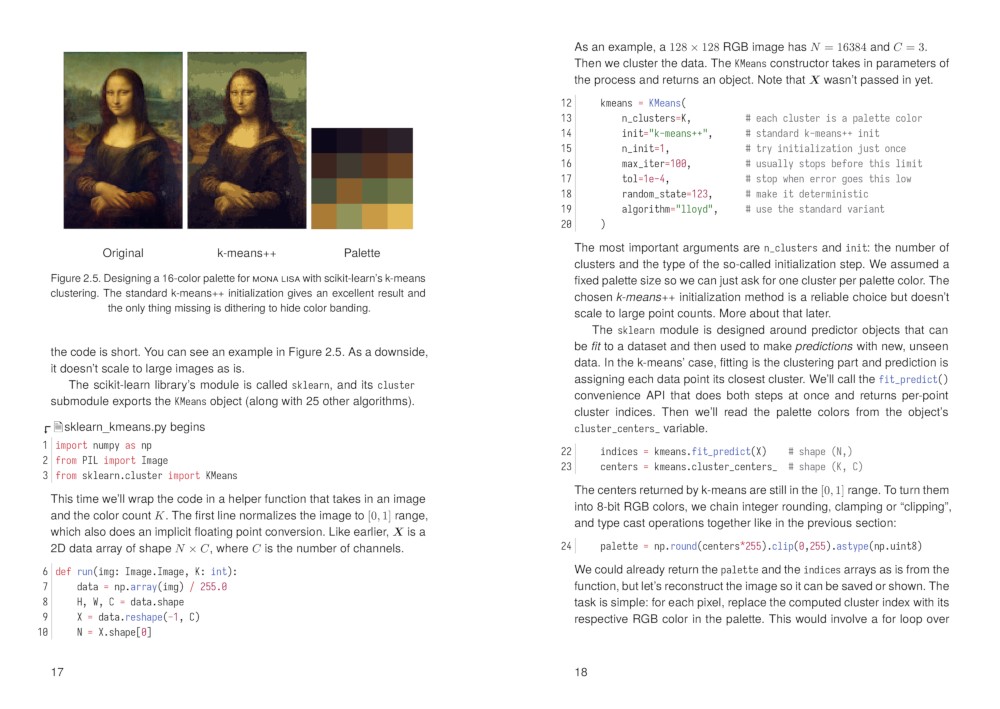
See how it looks below↓ or check out the table of contents.
Book information
- Release date
- 2026 (planned)
- Author
- Pekka R. H. Väänänen
- Format
- A5, full-color, 250 pp. Ring-bound softcover.
PDF, e-reader PDF. - Cover design
- Janya Markevich
How it’s structured
The first third of the book is a step-by-step guide to writing a “baseline” algorithm that’s both simple and effective. It has all the information needed to write a fully functional color reduction tool.
Part two introduces practical tricks everyone uses but textbooks often ignore such as palette color selection for ordered dithering.
Part three discusses more advanced methods from the academic literature, for example different k-means initialization schemes and PCA-based top-down clustering.
Table of contents
Part 1: Setting the Standard
- Popularity and bit cutting
- The trivial median cut
- Palette refinement with K-means
- Cutting by variance
- Error diffusion dithering
Part 2: Practical Improvements
- Structure-preserving dithering
- Ordered dithering
- Image preprocessing
- Perceptual color spaces
- Alpha difference formula
Part 3: Flights of Fancy
- k-means as a color quantizer
- Top-down clustering via 2-means
- Wu’s Famous 1991 Technique
- The axis of greatest variation
- Combined reduction and dithering
Epilogue and Appendices
- Epilogue: The historical Octree
- Image processing in Python
- Alpha difference formula derivation
- Proof of Celebi’s update formulas
Author bio
Pekka R. H. Väänänen (M.Sc. computer science) is a software engineer who writes about computer graphics on his website at 30fps.net.
He has worked on 3D model streaming and robot simulations at Umbra, and with 3D reconstruction and VR headset tracking at Varjo.
He also hacked on 2D graphics drivers as an intern at NVIDIA, a long time ago.
News
- April 23rd, 2026
- Table of contents updated with more dithering related chapters.
- Book subtitle changed to better reflect the new content.